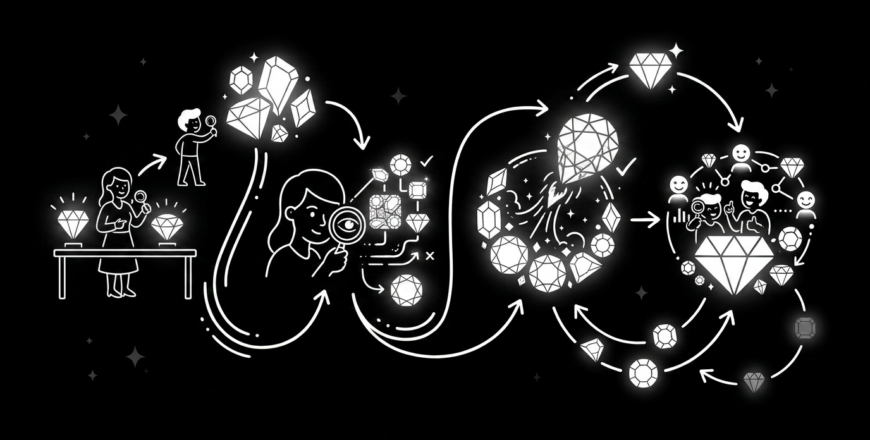
This course teaches creative entrepreneurs, founders, and cultural leaders how to see the difference between work that moves outward from a real center and work that borrows a surface that was never its own. Learners gain the conceptual framework and practical language to evaluate their own work, audit AI outputs with precision, and understand what makes creative work irreplaceable in a world where polished surfaces are cheap to produce.
The course is structured across two sections: Two Directions (Lessons 1.1–1.2) and The Copy Problem (Lessons 2.1–2.2). Four lessons move from the centrifugal versus centripetal framework to the style-versus-philosophy distinction to the AI capture-versus-structure audit to the strategic question of when the original still matters. Each lesson contains a teaching body, a summary, and a five-question comprehension check. The course ends with a twenty-question final assessment and a downloadable Depth vs Surface Audit checklist for quarterly use.
Learners complete the course with a named direction for their own practice, a traced style-to-philosophy analysis, a two-list audit of an AI output they made, and a clear view of where good-enough copy has quietly replaced an original relation in their work.
Subscribe to get the latest posts sent to your email.

This course provides conceptual frameworks for evaluating creative work in the context of AI-generated content. References to specific artists, musicians, and cultural movements are used as illustrative examples to explain the centrifugal versus centripetal framework and are not intended as comprehensive critical assessments of those figures or their work. All references to AI capabilities describe general patterns observed at the time of writing; the landscape changes rapidly and learners are encouraged to apply these frameworks to their current toolset.
Format: Self-paced, text-based with structured exercises
Language: English
Structure: 4 lessons across 2 sections, plus a 20-question final assessment
Visuals: Callout boxes and structured exercises within lesson bodies
Assessment: Five multiple-choice questions per lesson, all required to progress, and a twenty-question final assessment with a pass mark of sixteen out of twenty
Progression: Gated: each lesson unlocks the next only after its comprehension check is passed
Resource: A downloadable Depth vs Surface Audit checklist in PDF, for quarterly use
Founders and entrepreneurs in the creative sector who want a precise framework for evaluating their own work and the work they commission
Creative leaders, directors, producers, and curators who need language to defend the value of depth in professional settings
Community builders and cultural workers who want to understand what makes creative work worth paying for in an AI-saturated environment
Any creator who has felt that something is missing in AI-generated work but has not had the framework to name what
You cannot copy content of this page